Friday, 22 October 2010

Mary and Max

In recent years there has been a rapid decline in the output of clay animation films. This would appear to be due to the huge increase in CGI animation films from Hollywood, such as 'Wall E' (Andrew Stanton,2008), 'Up' (Pete Docter and Bob Peterson, 2009) and 'Toy Story 3' (Lee Unkrich, 2010) to name but a few. The highly polished, glossy sheen of these films seems to have made the homemade, hand-crafted aesthetic of clay animation a thing of the past. Not, that I am criticising the above mentioned films, on the contrary, I am a huge fan of each, all three being shining examples of just how charming and moving, huge budget Hollywood CGI movies can be when placed in the right hands. However, it is still saddening to see such an imbalance of animation styles on our screens these days.

Thankfully, Adam Elliot’s latest clay animation or ‘clayography’ 'Mary and Max' goes someway to redress this balance. A film of astonishing beauty, 'Mary and Max' is undoubtedly one of THE films of the year. Taking place over the course of twenty years and spanning two continents, the film follows the relationship of pen pals Mary, an eight year old child from Australia, and Max, a forty four year old Jewish man living in New York, suffering from Aspergers syndrome. Through this relationship, Elliot explores the film’s central themes of loneliness, mental illness, love and friendship, all with a deft balance of humour, sadness and subtlety.

Firstly, the clay animation is absolutely impeccable. With an aesthetic that is deceptively child-like, one could easily overlook just how painstaking a process the animation in 'Mary and Max' must have been. This is certainly to the animators and director’s credit, as the style is never too showy or distracting from the unfolding story. Instead, it draws its audience in delicately, allowing its tones and shades to assist in setting the mood.

The balance between the child-like tone and the film’s adult central themes is superbly offset by the narration provided by Barry Humphries, lending itself perfectly to the style of the animation, and allowing the story to be told in way that would be equally fitting to a child’s fairy tale. This is also true of the vocal talent provided by Toni Collette and Philip Seymour Hoffman as 'Mary and Max' respectively, with each adding an extra layer of depth to their characterisation.
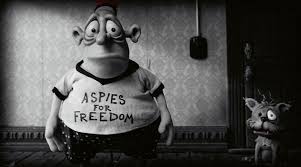
The combination of each of these elements makes for a truly exceptional piece of work. Although there are moments of heart-wrenching sadness and a lingering sense of melancholic loneliness throughout, there are also enough moments of quirky humour and touching tenderness to render 'Mary and Max', at times both uplifting and heart-warming. The depth and development of each and every character engages with the viewer in a manner, which would usually seem impossible through animation, such is the strength of Elliot’s script.

For me, 'Mary and Max' should be held in the same regard as Tim Burton’s 'The Nightmare Before Christmas' (1993) as a genuine classic of the clay animation genre. As a genre which is growing ever more redundant at the hand of Hollywood studios’ penchant for big budget 3D and CGI animations, gems such as Mary and Max will inevitably become an even rarer commodity in contemporary cinema, which is why EVERYONE should go see this film at least twice! It really is that good.

Monday, 18 October 2010

The American

As an artist known primarily for his work as a music video director and band photographer, Anton Corbijn’s latest project 'The American', starring George Clooney, could well be seen as a drastic departure from his well established roots. His debut feature 'Control' (2007) yielded great critical acclaim, although some may have noted that being a biopic of the late Ian Curtis, this didn’t really show a significant leap from his usual territory. This time out, however, Corbijn certainly appears to have branched out from those familiar surroundings taking on the spy-thriller genre.

'The American' follows the story of Jack/Edward (Clooney), an assassin and expert weapons builder as he embarks on a task to provide a fellow spy, Mathilde, with a weapon for her next kill. Whilst, on duty he befriends Father Benedetto, a local priest played Paolo Bonacelli, and finds himself romantically drawn to a local prostitute called Clara (Violante Placido). These relationships cause Jack/Edward to reconsider his lifestyle as a hired killer and he decides to make this his final job. Somewhat predictably, things don’t quite pan out so easily.

For various reasons, I found 'The American' crushingly disappointing. Being a huge fan of Corbijn’s work I had possibly set my expectations of the film a little high, yet I still believe 'The American' to be one of the most criminally missed opportunities of the year. It is not Corbijn’s visual skills and sensibilities that are at fault here. The film is replete with stunning shots of spectacular landscapes and beautiful expanses of scenery, which both perfectly emphasise the loneliness of the protagonist and the ability of the artist behind the camera. What IS at fault here is the sense of impending and crushing boredom that sets in around 20 minutes into the piece. Quite simply, 'The American' is a film in which nothing happens for approximately 110 minutes. For long periods, you could be forgiven for thinking that you had walked into an extended perfume or clothes commercial, with many a sequence of Clooney, seemingly performing on autopilot, driving and wandering around alone, looking effortlessly cool, but not doing anything! The only thing he really seems to do is have sex with local prostitute Clara, and with her share a small amount of clunky, unconvincing dialogue.

With regards to Corbijn’s directorial style, as mentioned above, he certainly knows how to compose superb shots and utilise his idyllic surroundings to the highest level. What must be questioned though is his lack of discipline or ability to find an even balance between style and narrative exposition. With such exquisite locations in Italy and Sweden at the heart of the film, Corbijn’s instincts as a photographer take over, resulting in far too many lingering shots that would look great in a holiday brochure, but ultimately hinder and slow the pace of the film.

The performances on display are all perfectly adequate, with the cast making the most of the lacklustre screenplay they have to work with. George Clooney does his usual George Clooney thing as well as ever, providing just the right amount of suave sophistication to the role. Most notably, however, is the performance of Paolo Bonacelli as Father Benedetto. Despite his role being relatively minimal, his presence immediately lights up the screen, conveying a much needed sense of charm and humour to the film.

Somewhere in the midst of this enormous catalogue of, admittedly, wonderful images, was the potential for a fantastically stylish spy movie. With a director of undoubted ability at the helm and a protagonist that appears to be custom built for George Clooney, 'The American' could genuinely have been something special. Sadly, in spite of the cast’s attempts there is nowhere near the required amount of characterisation or plot development. This major flaw makes it almost impossible to invest anything in the protagonist or any of the other key characters. Although commendable for his decision to remove himself from his comfort zone, I for one feel that Corbijn’s vast experience and finely honed abilities at shooting in the world of music and performers is where he clearly excels. Whatever he does choose to work on next, let’s just hope its results are closer to that of the majestic 'Control' and not this forgettable flop.

Friday, 15 October 2010

Leap Year (Ano Bisiesto)

If there is to be a more disturbing or divisive film released this year, it will certainly have to go some distance to top Michael Rowe’s minimalist debut feature Leap Year (Año bisiesto). A depiction of intense loneliness and psycho-sexual torture, or experimentation, depending on which side of the fence you lay, Leap Year raises many a difficult question, with regards to its seemingly complex gender politics.

It follows the life of Laura, played with vulnerable perfection by Monica Del Carmen, a lonely freelance journalist who lives alone in a small Mexican apartment. After a series of one night stands she meets and sleeps with Artur, played by Gustavo Sanchez Parra. Their subsequent relationship grows increasingly violent, with Artur apparently forcing Laura into a chain of appalling, aggressive and demeaning sexual acts. Gradually, however, what initially appears to be a case of intense male dominance, it is Laura who then sets about forcing him into acting out even further acts of sexual violence, reaching a finale that I will not reveal for you here.

Initially, Leap Year left me torn as to whether it is a stark, brutal, and unrelenting portrayal of a woman’s lonely existence, played out with superb complexity, or merely an exercise in repugnant, vulgar and gross misogyny. The first half of the film is pitch perfect. Rowe emphasises Laura’s loneliness beautifully, utilising the tiny confines of her apartment to provide an intimate insight into her sadness. He then goes on to further illustrate the intense nature of her desire for a partner, when we see her staring out of her window whilst masturbating, only to reveal that she is looking at couple just sitting together watching TV. Through a number of one night stands, Laura’s spiralling desperation is made all the more evident, as she is constantly rejected as soon as she tries to establish a connection after they have had sex. To this point in the film, Rowe exerts the correct amount of realism and intensity, drawing us with ease into the world of the protagonist.

However, it is upon the arrival of Artur that things begin to unravel. At first, he appears to be just another one night stand, yet he stays with Laura afterwards, showing her the attention she has so constantly craved from each of her previous encounters. He then returns for a second night, in which we see the first indications as to his violent tendencies. With each passing night that they have sex, his brutality becomes, at times, almost impossible to bear. We see scenes of rape, beating and revolting humiliation, in which Artur forces her to masturbate as he urinates on her.

It is sequences such as those mentioned above that initially left me torn as to Rowe’s intentions with Leap Year. Although the acts are irrefutably degrading, it seems that Laura is the one to really be taking pleasure from them, eventually placing her in a position of power, with her making demands of Artur. However, in spite of this, I, on reflection, believe the second half of Leap Year to be a piece of vile misogynist trash. No matter what Laura’s intentions may or may not be, I can find no justification for creating a ridiculously protracted scene of a woman taking pleasure from a man pissing on her. Or, for that matter, having cigarettes put out on her breasts, or being beaten with a belt.

While some may argue that it is the unflinching, torturous moments which are actually at the heart of the film’s deconstruction of Artur’s character, I could find no argument to stand up against the fact that Leap Year serves only as faux intellectual torture porn.

Friday, 24 September 2010

Rebels Without a Clue

With debut feature Rebels Without a Clue, director and writer Ian Vernon attempts to blend elements of so-called gritty social-realism with black humour, in a film that is about as misguided as it’s unfortunate title suggests. The tagline, ‘Teenagers with guns, drugs and a cool car. All they need to do is lose their virginity’, doesn’t exactly fill one with hope. Its tone being one of slight desperation to attract the teenage, Skins generation via a, shall we say, lack of subtlety and an abundance of brash clichés. It tells the story of four teenagers, who inadvertently interrupt a drug deal and find themselves in possession of drugs, money and a Cadillac. Whilst being tracked by an unnamed thug, they decide to head for Spain in an attempt to escape their current, mundane lives in Manchester.

The key problem with Rebels Without a Clue is the unconvincing and occasionally awkward script. In a film that is primarily centred on an ensemble cast of four, the relationships and the dialogue need to be sharp and engaging if they are to draw one in, yet here, often feels forced and heavy-handed. This is most likely due to the in-authenticity of the interaction between the teens. What should be an entertaining insight into the lives and minds of a group of teens, ends up sounding like an ill-advised guess as to how this generation communicate. This is no more evident than in the all too frequent moments in which, without exaggeration, almost every character to appear on screen refers to Mark (Rik Barnett) as “wanker”. If this is an attempt at humour it comes across as, at best, lazy, and at worst, embarrassing, as though throwing in this word every other minute is somehow going to make teenagers laugh. If not, then it may be that Vernon feels that the constant use of swearing adds to the grittiness or the realism. It doesn’t.

Similarly, the cast on offer fails to capture any sense of realism or comedy. With the exception of Lucy Brennan, who plays Kylie, the performances are wooden and uneven to say the least, although, admittedly, they probably weren’t helped by the equally flawed screenplay. The worst offender though, has to be that of Hylton Collins, whose portrayal of the nameless thug chasing the gang really has to be seen to be believed. In a performance that is so cringe-inducingly bad, I am left unsure as to whether it is deliberately intended as part of the humour. Sadly, I don’t think it is. Dressed all in black, with the words ‘love’ and ‘hate’ tattooed across his knuckles, the thug should have at least seemed intimidating if only in a comic book sense. Unfortunately, the performance holds more in common with Keith from TV show The Office than a scary gangster type. You can almost feel the energy being sapped from the screen whenever he appears, which is a fundamental flaw, considering that this is the character who really needs to be setting the pace in his pursuit of the gang.

Rebels Without a Clue suffers mostly by failing to create an identity for itself. Described as a black comedy, it barely raises enough laughs to call itself a comedy, whilst also lacking anything one might even remotely consider to be gritty or realistic. Additionally, the lack of any consistent or cohesive characterisation further adds to the overall imbalanced tone of the film. All too often, one feels as though Vernon assumes that by simply combining swearing teenagers with dangerous elements such as drugs or guns is an immediate recipe for success, while the reality is that merely putting these components together without a genuine purpose is destined to disappoint.

Wednesday, 8 September 2010

The Last Exorcism

Over the past few years, documentary-style horror movies seem to have become a fairly frequent occurrence, often achieving varying degrees of success. On one hand we’ve seen wonderfully terrifying examples such as ‘Rec’ (2008) and ‘Paranormal Activity’ (2009), each, in my view, worthy of standing up as true classics of the genre. Equally, however, some haven’t quite delivered in the same way; 2008’s ‘Cloverfield’ and 2010’s ‘Rec 2’both highlighting, albeit in different ways, just how easy it is to get things wrong when shooting in this style. In the case of Daniel Stamm’s ‘The Last Exorcism’ we find a film that embodies many of the qualities that make this genre so effective, yet also manages to implode quite spectacularly due to a few misguided steps.

‘The Last Exorcism’ takes the form of a documentary, following preacher and ‘exorcist’ Cotton Marcus, played superbly by Patrick Fabian, as he sets out to show the world the tricks of the exorcist trade and to reveal the fraudulent and exploitative ways of the church. Somewhat predictably, this doesn’t quite go to plan.

Although the plot and exposition of the film are both highly derivative and explicit in their influences, for large sections ‘The Last Exorcism’ works beautifully, slowly building up the tension and creating an atmosphere of suspense in a way that’s comparable to that of ‘Paranormal Activity’; specifically the moments in which the camera is focussed on the bedroom whilst the couple are sleeping. With these moments, the fear manifests itself in the form of anticipation, rather than what is actually happening on-screen. Examples of this technique can be seen as Cotton and his team are following an apparently possessed Nell through the house. As she moves into different rooms and out of the camera’s sight, one can clearly draw comparisons with the style employed in ‘Paranormal Activity’. Similarly, the scene in which she is alone behind her locked bedroom door, yet the sounds of another voice and a baby crying can clearly be heard, also make for extremely unsettling viewing . In sequences such as this, Stamm exemplifies just how scary and powerful horrors of this kind can be, with literally nothing other than the audience’s imagination providing the terror.

The quality of the performances from the key cast members also adds to the scariness, with no one over-acting or trying to compensate for the film’s carefully understated tone. Ashley Bell’s performance as Nell deserves particular praise for its vulnerability and sensitivity, making the moments of her possession all the more frightening. It is this obvious technique of less-is-more, regarding the cast’s performances, that undoubtedly provides ‘The Last Exorcism’ with its creepiest and spookiest moments, allowing the tension to unnerve its audience instead of screaming at you to be scared.

How frustrating it is then, when in the film’s final act, it decides to abandon every element that had worked to this point, in favour of an ending which is so preposterously bad that it essentially destroys all of the groundwork which was laid before. The realism of the single camera style of shooting is hurriedly discarded to make way for a number of cut-away and reaction shots that simply don’t add up or make sense if the action were truly being captured by one camera. Furthermore, the ‘twist’ in the plot really is laughable. I won’t reveal the ending here, for anyone that is thinking of seeing the film should not be put off by its final 10 minutes, yet when you come away from ‘The Last Exorcism’, the prevailing feeling is one of disappointment at what could have been, rather than appreciating just how good a film it was for around eighty minutes. Such a shame, as given a little more thought, ‘The Last Exorcism’ could well have been one of the year’s best horrors.

Friday, 3 September 2010

Interpol, 'Interpol'

Over the past eight years, Interpol, for me at least, have been without question the most important and consistent band currently releasing music. From the very beginning they have possessed an air of majesty and beauty that has became distinctly synonymous with the band, their 2002 debut ‘Turn on the Bright Lights’ being one of, if not THE, defining indie album of the decade. It can not be overstated just how great an achievement ‘Bright Lights’ is, with tracks such as ‘Obstacle 1’ and ‘Stella…’ showing a maturity and deftness of touch that many bands could only dream of capturing in their first outing.

However, when a debut of such quality is released it is inevitable that doubts will be cast over the band’s ability to follow it up with something of equal worth, with so many bands releasing greatly hyped and well received debuts, merely to fall by the wayside on their second offering. This is an obstacle which Interpol have consistently avoided with consummate ease, with both 2004’s ‘Antics’ and 2007’s ‘Our Love to Admire’ each developing on the qualities evident in ‘Bright Lights’ yet displaying a greater leaning towards epic, and at times cinematic atmospherics, culminating in ‘Our Love to Admire’s’ closer ‘The Lighthouse’, a track of haunting melancholy to rival any of Interpol’s previous work.

Understandably then, the three year wait for self-titled album number four has been a painfully long one. Surely Interpol would once again deliver an album to blow anything else from 2010 out of the water. Sadly, it is with a heavy heart I must report that with ‘Interpol’, the band for the first time, has failed to meet the high expectations they so regularly set for themselves with each release. An album of two halves, ‘Interpol’ begins with so much promise, yet around the halfway mark, gradually falls apart.

Album opener ‘Success’ sets the tone superbly, with the kind of grand production and typically introspective lyrics and delivery from Banks that usually mark the opening of each Interpol record. The album continues with similar promise in the form of ‘Summer Well’, a piano-led track which builds toward an infectious chorus. ‘Interpol’ then reaches its peak with two of the band’s finest moments to date. ‘Lights’ grows and swells in manner that echoes ‘The Lighthouse’, becoming even more haunting and spine-tingling with every listen, placing itself as a true masterpiece amongst the Interpol canon. ‘Barricade’ also finds the band hitting their stride, boasting a deceptively catchy guitar hook and a magnificent Banks vocal as it reaches the chorus. In fact, ‘Barricade’ holds many of the components that could have made ‘Interpol’ a far more enjoyable listen, as from this point onwards the album opts for a more subtle, atmospheric direction.

The results are somewhat frustrating, as many of the tracks lack the edge evident in both their previous works and indeed the first half of the album. Although they aren’t bad, they certainly aren’t anything to get too excited about. ‘Safe Without’ tries its best to find a hook or a tangible thread for the listener to grab onto but ultimately ends up sounding just a bit dull. Similar symptoms of tediousness are present in ‘All of the Ways’, trying its best to replicate the mood of ‘The Lighthouse’ but falls well short, feeling laborious and forced at over five minutes.

Although ‘Interpol’ is clearly not quite the album I had hoped for, it still has enough great moments to ensure that old and new fans alike will be satisfied. Its highlights are more than capable of holding their own against classics from Interpol’s near faultless back catalogue, indicating that there is still a wealth of potential for even more to come from this extraordinary band.

Thursday, 2 September 2010

Scott Pilgrim vs the World

It appears to be the case that I am somewhat alone in my view of Edgar Wright’s ‘Scott Pilgrim vs The World’. I have just been having a peek at some of the reviews and comments other viewers have made on the IMDB website and have found almost unanimous love and praise for this film. Additionally, it has also been on the receiving end of great critical acclaim and approval. However, I must admit that I found ‘Scott Pilgrim’ to be a distinctly average and overall disappointing piece of work. For many reasons, it fails to capture any of the wonderfully unique qualities which have become inherent in the work of Edgar Wright, of whom I am a big fan.


As a director of such ability and creativity I had hoped for so much more than what is delivered in ‘Scott Pilgrim’. Whereas Wright has always had the sharp wit and precise focus of Simon Pegg’s writing to steer their previous projects forward, ‘Scott Pilgrim’ feels more like an extensive brainstorming session of potentially good ideas, yet lacks any sense of control or direction. With TV show ‘Spaced’ and movies ‘Shaun of the Dead’ and ‘Hot Fuzz’, the pairing of these two consistently made for highly original viewing, with a truly majestic blend of genre splicing and homage, held together by a string of flawless performances and beautifully constructed scripts.

While the film is visually a huge success, with all the hallmarks of Wright’s directorial style evident in it’s scenes of computer game homage and comic book violence, it lacks enormously in humour and substance. The plot, about Scott having to defeat the seven evil exes of his girlfriend, frankly becomes redundant in the hands of Wright, with ‘Scott Pilgrim’ essentially becoming no more than a canvas for him to show off his skills as a visual artist as opposed to a director with the ability to drive a story in the right direction. For instance, the vast majority of the moments of homage and parody appear to serve no purpose whatsoever and are often entirely irrelevant to what’s going on in the film. It is littered with nods to moments from computer games that are at no point mentioned nor make any sense. This is a major flaw, which should be glaringly apparent to anyone who is a fan of Wright’s previous work, in which any element of parody or homage made sense, and more importantly added to the story.

As a result of such loose direction ‘Scott Pilgrim’ also fails to raise many laughs. The few that do exist often arise from a disappointingly under-used Kieran Culkin, whose perfectly understated performance as Wallace, Scott’s gay room-mate, is one of the film’s undoubted highlights. This overall lack of humour and engagement with the audience left me feeling that ‘Scott Pilgrim’ was more of a missed opportunity than a terrible film. Furthermore, with the input of someone such as Simon Pegg, one can only imagine how much better ‘Scott Pilgrim’ could have been. A project such as this could not have been placed in better hands than those of Edgar Wright, yet still it somehow falls way below par.