Monday, 21 February 2011

Despicable Me


In an attempt to establish themselves as genuine rivals to the sublime Pixar Studios, Universal Pictures offers up its debut 3D animation in the form ofDespicable Me, directed by Pierre Coffin and Chris Renaud (2010). With an output of unprecedented consistency and visual resplendence over recent years, it may seem an almost impossible task to take on the work of Pixar without conceding to the inevitable conclusion that no other studio are quite ready to compete at the present time. Just take Toy Story 3 (Lee Unkrich, 2010), Up (Pete Docter and Bob Peterson, 2009) and Wall-E (Andrew Stanton, 2008) as such glowing examples of what Universal are up against. With this in mind, I believe that to make such comparisons with the above-mentioned contemporary classics would be both too easy and unfair on the film in question.
Despicable Me follows the evil Gru, voiced brilliantly by Steve Carell, and his constant and usually failed attempts to become the world’s greatest criminal mastermind. Whilst trying to thwart his arch nemesis, Vector (Jason Segel), Gru adopts three innocent, young orphaned girls, in the hope that they will be able to assist him in his plan to steal a magical shrink-ray gun; therefore allowing him to shrink and steal the moon. What follows is an inevitable, yet thoroughly enjoyable and entertaining journey for Gru, as his love for his newly adopted girls begins to outweigh his desire for criminal notoriety.
One of Despicable Me’s strongest assets are the voice acting on offer. Carell, a name to usually steer me a country mile clear of anything with which he is associated, is absolutely perfect as Gru. His comically evil Russian accent is a superb accompaniment to the lead character’s appearance. Equally outstanding is the vocal acting of Russell Brand as Gru’s long-suffering inventor, Dr Nefario, providing some of the film’s funniest moments merely through the sound of his voice, without falling into the trap of overstating the performance.

The film’s visuals are also beautifully executed, with the darkness of Gru’s mansion being expertly offset to the bold, bright colours of the outside world. The appearance of Gru’s tiny workers, small yellow creatures in dungarees, is also one of Despicable Me’s major visual strengths, adding to the movie’s vibrant aesthetic.
Whilst the storyline is incredibly predictable from start to finish, and many of its comic set pieces highly derivative from a whole host of children’s movies throughout the years, Despicable Me is still a perfectly adequate and thoroughly entertaining family film. Although it may not be quite in the same league as many of Pixar’s latest productions, it is certainly capable of holding its own against most of the other animated family films currently being churned out by the Hollywood CGI production line. 

Saturday, 22 January 2011

The Portuguese Nun

As a film that has been met with almost unanimous critical praise, I am still wondering whether it was in fact Eugene Green’s 'A Portuguese Nun'. (2009) that I painfully and, eventually, begrudgingly endured. For this is without question one of the most tedious, long-winded and utterly pretentious films I have put myself through in a very long time.
It focuses on Julie (Leonor Baldaque) a French actress who goes to Portugal to act in a film, in which she will play a nun. Throughout her stay she meets an array of different characters, yet as these encounters come and go, she remains fascinated by a nun whom she regularly sees praying. After eventually meeting the nun she is finally filled with a sense of purpose and meaning in her life.

What, in essence, could make for an interesting piece of character exploration, somehow fails to connect or engage with the viewer in any way whatsoever, descending into a well of unexpurgated monotony. This is mostly due to Green’s agonisingly slow and drawn-out approach to the film. In each and every aspect it is sluggish and lacking in spark or momentum.

Take, for instance, Green’s camera work. Moving at a snail’s pace, the camera tends to dwell for protracted periods of time on the various landscapes in which Julie inhabits. This persistent technique, whilst intended to represent the protagonist’s state of mind and draw the audience further into her world, ultimately produces an effect of slow motion; as though one is being dragged through both the scenery and proceedings.

This technique continues with the scenes of conversation between Julie and the various characters she comes into contact with during her stay. Almost every conversation or moment of interaction is conducted via a series of cuts between still shots of each characters face, very often lingering on Julie’s for so long that every time the camera focuses on her an even further sense of impending boredom is induced.

Camera work aside, it is the air of crass pretention that equally bothered me while watching 'A Portuguese Nun'. The sense of smugness that emanates through the screen is almost palpable. At times I felt as though my patience was being deliberately tested, and that the desire to simply stop watching was a result of my inability to stay engaged with Green’s minimalism rather than at his ineptitude at effective storytelling.

On reflection, I wonder if it is this fear of being regarded as stupid or incapable to engage with such faux art-house nonsense that has led to 'A Portuguese Nun' being so highly regarded by so many critics. I have tried and failed to find any genuine positives or redeeming features and my endeavours have bee completely without success. The only recommendation I can possibly offer anyone still interested in seeing A Portuguese Nun is to steer well clear!

Thursday, 20 January 2011

Black Dynamite

Ever since Scary Movie (Keenan Ivory Wayans) was released back in 2000 the art of spoof has taken a brutal and savage mauling. Having set in motion a chain of unspeakably bad, not to mention painfully unfunny follow ups to the original, Wayans also paved the way for the likes of Epic Movie (Jason Friedberg and Aaron Seltzer, 2007), Meet the Spartans (Jason Friedberg and Aaron Seltzer, 2007) and Dance Flick (Damien Dante Wayans, 2009)to name but a hideous few. For this reason, I approached Scott Sanders’s Black Dynamite (2009) with more than just a hint of trepidation.    
Thankfully, to my pleasant surprise, Black Dynamite manages to buck this recent trend by showing just how good spoof comedies can still be. Set in the 1970s and taking its influence from films of the same era such as Shaft (Gordon Parks, 1971) and Black Belt Jones (Robert Clouse, 1974) the story follows Black Dynamite (Michael Jai White), a hilariously tough-talking ladies man, as he sets out to avenge the death of his brother. Armed with both a 44-Magnum and a set of nunchucks, he fights, intimidates and charms his way around town in order to find his brother’s killer. The resulting chain of events makes for one of the most brilliantly silly and sublimely funny spoofs of the decade.
Possessing a tone not too dissimilar from the classic TV show Police SquadBlack Dynamite throws any sense of subtlety aside, favouring a far more direct and farcical approach to its humour. The Kung Fu scenes in particular display the kind of deliberately awful sound dubbing and camera work that one might find in the kind of low-budget ‘blaxploitation’ films of the time, as well as the kind often found in similarly low-budget Kung Fu movies, such as Ninja Terminator (Godfrey Ho,  1985).
Michael Jai White also provides a great deal of the film’s funniest moments, playing the part of Black Dynamite with just the right amount of self-aware absurdity, whilst ensuring that the performance never becomes too broad or brings about any sense of self-parody.  
In fact, this element of perfectly poised expositon in not only the performances, but the movie as a whole, is central to its overall success. Shot in Super 16 Film and backed by a soulful, 70s soundtrack, Black Dynamite both looks and sounds thoroughly authentic, going someway to enhance the ludicrous nature of the comedy.
The script on offer is equally preposterous, providing moments of laugh out loud hilarity; the scene in which Black Dynamite and his gang attempt to decipher ‘code Kansas’, results in one of the film’s funniest routines and comedic payoffs.
In many ways, the key to Black Dynamite’s success is its deference to the spoof techniques employed by many of its unbearably poor and lazily put together contemporaries, as well as Sanders’s decision to carry the piece in a more traditional spoof direction. Through combining such a perfect aesthetic with a plot and screenplay of ridiculously over-the top humour, hopefully, Sanders may just have helped put the spoof genre back on track.

Thursday, 6 January 2011

Betrayal


Having just left the year 2010, a year, in which, I believe few would argue had been a particularly impressive year for the world of cinema, it is with a hint of disappointment that I must bring to your attention a DVD release of such crashing and unbridled dross so early on in 2011. The film in question is Haakon Gundersen’s Betrayal (2009), starring none other than Lene Nystrom of 90s pop group ‘Aqua’ fame. 

Set in Nazi occupied Oslo, Betrayal tells the story of a group of Wehrmacht officers and a local club owner, Tor Lindblom (Fridtjov Saheim), as he illegally supplies them with a wide range of industrial and recreational amenities. Unfortunately for Tor, he falls in love with nightclub singer Eva Karlsen (Nystrom), whom, as luck would have it, just so happens to be a British secret agent. When an outside party decides to send in an officer to check these transactions are legal, things take an inevitable turn for the worse. 
For a film of such drivelsome melodrama and desperation in its attempt to be taken seriously, it is a truly remarkable piece of catastrophic casting to place the lead singer of ’Aqua’ as its female lead. Not that her performance is particularly bad, it is just somewhat difficult to get behind the hero of a film swamped in Nazi corruption, who also happens to be ‘Barbie’. However, this is certainly not the primary cause of Betrayal’s vast and numerous shortcomings.
One of the most obvious and notable drawbacks of Betrayal is the absolutely abysmal score; persistently using short, sharp bursts of strings in a fashion, which is not only ineffectual, but massively overstated to the point of tackiness, ultimately ruining any potential for tension or suspense. This is also true of the film’s script, as it slowly and clumsily meanders through scene after scene of clunky, wooden and unconvincing dialogue.  
Similarly, the performances are far too melodramatic; diminishing any traces of realism and making any form of engagement with both characters and plot, virtually impossible. Admittedly, the poor quality of the screenplay doesn’t help matters, yet many of the cast do little to raise the bar.  Take for example Gotz Otto’s performance as SS Major Kruger, the officer with whom Tor conducts most of his dealings. A character of such vile corruption and immorality would surely have benefited from a performance of measured understatement in order to convey the necessary demeanour of menace and danger to the role. Instead, Otto’s portrayal bears more similarities to that of a pantomime baddie than a genuinely loathsome villain.
It is essentially this preposterously unbalanced tone in each and every aspect of the piece that lies at the heart of Betrayal’s failure to capture both the mood of the era, as well as the imagination of the audience. Whilst trying to juggle heavyweight political and ethical issues with ‘Barbie Girl’ and a ‘bad guy’ more akin to Captain Hook than a high ranking Nazi officer, Betrayal manages to stumble and fall over each and every hurdle in its path. With its bizarre combination of elements, the resulting effect is one of a film that hasn’t quite figured out what it wants to be. On the one hand, there is the half-hearted attempt at providing an informative commentary on complex wartime issues; on the other is Gundersen’s stab at creating an espionage/crime thriller. Sadly he doesn’t even come close to achieving either. 

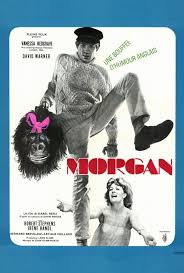
Morgan: A Suitable Case for Treatment


As a film that deals with themes of insanity, jealousy, romance and class division, whilst simultaneously skipping between madcap comedy and tragic love story, it is little wonder that Morgan: A Suitable Case for Treatment (Karel Reisz, 1966) achieves rather mixed results. It details the descent into madness of the already psychologically unstable Morgan (David Warner), as he is forced to deal with the break-up of his marriage to Leonie (Vanessa Redgrave) and her plans to marry her lover Charles Napier (Robert Stephens).   His inability to deal with the reality of his situation forces him into a world of fantasy, whereupon he sees things and people as wild animals in the jungle, viewing himself always as a gorilla. This particular obsession with gorillas increase along with his plight, with the lines of reality and fantasy becoming blurred as he inexplicably mimics the creatures in public to the bemusement of those around him, culminating in an extraordinary finale, which we will come to shortly.
The key issue I had when watching Morgan was its difficulty in creating a definitive identity for itself. With nowhere near enough funny moments to call itself a comedy, nor enough weight behind the spiralling mental condition of its protagonist to be considered a ‘serious’ film, Morgan falls short of reaching either with any real conviction. However, this is not to say that the film fails entirely. There are certainly enough positives on offer to remain pleasantly entertaining throughout, yet it never quite fulfils its potential to be something special.
Morgan’s most obvious asset is that of David Warner and his performance of Morgan. His on-screen charm combined with the understated menace of his portrayal of the young, unhinged artist is genuinely brilliant, providing the vast majority of the film’s comic moments. The delivery of such fantastic lines as: “You know, I believe my mental condition is extremely illegal.” are perfectly pitched between off-the-wall humour and a sense of growing madness. 
Director Karel Reisz’s visual sensibilities also lend themselves well to the piece, creating, at times, an aesthetic of superb originality. The use of cutting-in images of animals in the wild as a means to illustrate Morgan’s ever-increasing detachment from reality, works beautifully. This technique is largely what makes the film’s remarkable climax quite so unique, as we see clips of the original King Kong (Merian C. Cooper and Ernest B. Schoedsack, 1933), in particular the scene in which King Kong saves Ann and fights the dinosaur, interspersed with Morgan watching the wedding reception of Leonie and his love rival Charles, as he imagines himself rescuing her from the monster. The resulting tone is one of wonderfully inventive comedy; a tone which one is left wishing had been more present throughout.
Overall, Morgan: A Suitable Case for Treatment is a perfectly adequate and mildly entertaining piece of British, 1960s filmmaking. While its cult status is assured due to its lack of concern with commercial viability, it is the absence of a suitably disciplined narrative and direction that are ultimately at the heart of the films exclusion from the canon of great British movies from the same era.

Thursday, 16 December 2010

Road to Las Vegas

Rarely does a documentary manage to encapsulate its subject matter with the kind of beauty and non-judgemental insight as Jason Massot’s latest film Road to Las Vegas (2010). Spanning four years, it follows the lives of African American couple Vanessa and Maurice Melton and their five children as they leave home and set off on an indefinite road trip to Las Vegas, where, as Vanessa believes she was told in a message from God, the family will prosper and find a better home. With no more than 300 dollars to their name and using their car as a home, Road to Las Vegas provides a superb insight into the many difficulties and personal traumas the family are forced to deal with, in an account that is at times painfully personal, yet conducted with sensitivity and sympathy from Massot throughout.

Unfolding in the style of a traditional road movie Road to Las Vegas depicts the false promise of new beginnings for a family such as the Melton’s, particularly in Las Vegas, where it’s booming tourist industry offers the opportunity of employment and the ideal setting for a family in search of work and a new home. However, on arrival, Maurice realises that things may be somewhat more problematic than first thought. In the first year of the film he initially finds the kind of job offers he was hoping for, only to realise that due to the enormous demand for work, the income rate is ludicrously low. Rather than accept these unfair conditions, the family continue to search for better paid work. Unfortunately for them, their search is met with similar results.
As the film progresses the family’s plight begins to deteriorate with each year. It is revealed that Maurice has an addiction to crack cocaine, forcing him to leave the family and live on the streets, whilst Vanessa begins seeing one of Maurice’s friends. It is moments such as these where Massot’s abilities really come into play. At no point does the documentary take sides during these family troubles or make any kind of judgement, it simply captures, with unflinching detail, the situation of the family, allowing the audience to think for themselves.

At times, Massot’s film also makes for deeply harrowing viewing. One of the most notable examples of this is Maurice’s brother Lloyd’s funeral, in which we see Maurice, usually extremely tough on the surface, in a state of debilitating grief, weeping and sobbing openly at his brother’s coffin. Although scenes such as this may sound intrusive, Massot expertly walks a fine line between invasiveness and insightfulness. For some, these scenes will undoubtedly be unsettling and uncomfortable. However, in my view, they are a necessary part of the documentation of the family’s journey and their losses along the way. Furthermore, in the context of the film, Lloyd’s death does appear to play an integral part in Maurice’s determination to get clean and support his family.

In contrast to the above-mentioned moments of sadness and grief, the film also succeeds in highlighting the love that both Vanessa and Maurice have for their family. Despite their numerous issues, the couple’s love for their children does remain at the heart of the film, as does the children’ s amazing ability to deal with the spiralling troubles directly surrounding them. In many ways, Road to Las Vegas could also be read as a testament to the family’s unremitting love for each other, as well as the grit and determination of Vanessa and Maurice to stay together through such desperate times.

It is this superbly balanced and wonderfully constructed snapshot of four years condensed into ninety minutes, which make for such a brilliantly engaging and informative piece of work.

Wednesday, 17 November 2010

The Hammer and Tongs Collection

Anyone with even a passing interest in the world of film and music videos will no doubt be familiar with the work of director/producer duo Garth Jennings and Nick Goldsmith, a.k.a. Hammer and Tongs. Whether this be as a result of their more recent feature films such as The Hitchhikers Guide to the Galaxy (2005) and Son of Rambow (2007) or their hugely iconic music videos for the likes of Blur, Supergrass and REM, you will almost certainly have encountered some form of their work over the past fifteen years or so.

For the first time in their career, The Hammer and Tongs Collection sees the bulk of the pair’s efforts assembled over one disc, including an array of music videos, short films and a behind the scenes documentary thrown in for good measure. Whilst many fans of Hammer and Tongs, myself included, will simply be glad to see the release of such a collection, I feel that despite its moments of unquestionable genius, it is still, at times, a little frustrating. However, theses flaws, which I will touch upon later, are vastly outweighed by some of the most beautifully inventive and innovative music videos from the past two decades.

Some of the more obvious highlights appear in the form of Blur’s ‘Coffee and TV’ (1999) and Supergrass’s ‘Pumping on Your Stereo’ (1999), whose iconic images of walking milk cartons and gigantic, bendy bodies have firmly cemented their place among pop culture’s most memorable moments. This is also true of Fatboy Slim’s ‘Right Here Right Now’ (1999), in which we see the beginning of time followed through to the evolution of man over the course of a three and a half minute song. Fairly ambitious I think you’ll agree.

There are also a number of slightly lesser known gems on this collection, which some may not be quite so familiar with.  For instance, Beck’s ‘Lost Cause’ (2003) is one of the most magically creative and deftly constructed videos in recent memory. Other notable pieces include Eels’s ‘Last Stop This Town’ (1998) and Moloko’s ‘Flipside’ (1998), each possessing surreal, hallucinogenic qualities in equal measure.

Unfortunately, there are one or two forgettable moments. Radiohead’s ‘Nude’ (2007) captures a slow-motion, dream-like effect, which grows tiresome very quickly, the final product being something close to the visual equivalent of a yawn. Not necessarily a bad thing, but hardly a memorable experience. Especially when placed alongside some of the above mentioned masterpieces. The Wannadies ‘Little by Little’ (2003) and Pulp’s ‘A Little Soul’ (1998) also fail to reach the same levels of quality found in the collection’s finer inclusions.

As mentioned previously, there are one or two other flaws to be found. The three short films included, Eiffels Blessing, Toast the Cat and Polish Plums are all very short and extremely unremarkable. Avid fans might enjoy these as a rare treat and a look at the duo’s earlier work. Personally, I felt as though they were included solely to boost the number of features listed on the collection.

However, the most disappointing aspect of the DVD is the shabbily put together documentary. A seemingly random compilation of behind the scenes footage from a number of shoots from over the years, rarely provides any insight or information; a truly missed opportunity to take a glimpse at the inner-workings of one of the most talented partnerships in the business. What makes the documentary seem even more pointless are the hugely extended and unnecessary behind the scenes clips from ‘Son of Rambow’, which has no other mention on the DVD and appears totally pointless in the context of the DVD.

Still, these drawbacks, frustrating as they are, should not taint what is an absolutely outstanding collection of works from such a talented pairing. The inclusion of recent videos, such as the magnificent ‘Cousins’ by Vampire Weekend emphasises just how relevant Hammer and Tongs remain, and furthermore, that there is more than enough potential for just as many great works to look forward to in the future.