Thursday, 16 December 2010

Road to Las Vegas

Rarely does a documentary manage to encapsulate its subject matter with the kind of beauty and non-judgemental insight as Jason Massot’s latest film Road to Las Vegas (2010). Spanning four years, it follows the lives of African American couple Vanessa and Maurice Melton and their five children as they leave home and set off on an indefinite road trip to Las Vegas, where, as Vanessa believes she was told in a message from God, the family will prosper and find a better home. With no more than 300 dollars to their name and using their car as a home, Road to Las Vegas provides a superb insight into the many difficulties and personal traumas the family are forced to deal with, in an account that is at times painfully personal, yet conducted with sensitivity and sympathy from Massot throughout.

Unfolding in the style of a traditional road movie Road to Las Vegas depicts the false promise of new beginnings for a family such as the Melton’s, particularly in Las Vegas, where it’s booming tourist industry offers the opportunity of employment and the ideal setting for a family in search of work and a new home. However, on arrival, Maurice realises that things may be somewhat more problematic than first thought. In the first year of the film he initially finds the kind of job offers he was hoping for, only to realise that due to the enormous demand for work, the income rate is ludicrously low. Rather than accept these unfair conditions, the family continue to search for better paid work. Unfortunately for them, their search is met with similar results.
As the film progresses the family’s plight begins to deteriorate with each year. It is revealed that Maurice has an addiction to crack cocaine, forcing him to leave the family and live on the streets, whilst Vanessa begins seeing one of Maurice’s friends. It is moments such as these where Massot’s abilities really come into play. At no point does the documentary take sides during these family troubles or make any kind of judgement, it simply captures, with unflinching detail, the situation of the family, allowing the audience to think for themselves.

At times, Massot’s film also makes for deeply harrowing viewing. One of the most notable examples of this is Maurice’s brother Lloyd’s funeral, in which we see Maurice, usually extremely tough on the surface, in a state of debilitating grief, weeping and sobbing openly at his brother’s coffin. Although scenes such as this may sound intrusive, Massot expertly walks a fine line between invasiveness and insightfulness. For some, these scenes will undoubtedly be unsettling and uncomfortable. However, in my view, they are a necessary part of the documentation of the family’s journey and their losses along the way. Furthermore, in the context of the film, Lloyd’s death does appear to play an integral part in Maurice’s determination to get clean and support his family.

In contrast to the above-mentioned moments of sadness and grief, the film also succeeds in highlighting the love that both Vanessa and Maurice have for their family. Despite their numerous issues, the couple’s love for their children does remain at the heart of the film, as does the children’ s amazing ability to deal with the spiralling troubles directly surrounding them. In many ways, Road to Las Vegas could also be read as a testament to the family’s unremitting love for each other, as well as the grit and determination of Vanessa and Maurice to stay together through such desperate times.

It is this superbly balanced and wonderfully constructed snapshot of four years condensed into ninety minutes, which make for such a brilliantly engaging and informative piece of work.

Wednesday, 17 November 2010

The Hammer and Tongs Collection

Anyone with even a passing interest in the world of film and music videos will no doubt be familiar with the work of director/producer duo Garth Jennings and Nick Goldsmith, a.k.a. Hammer and Tongs. Whether this be as a result of their more recent feature films such as The Hitchhikers Guide to the Galaxy (2005) and Son of Rambow (2007) or their hugely iconic music videos for the likes of Blur, Supergrass and REM, you will almost certainly have encountered some form of their work over the past fifteen years or so.

For the first time in their career, The Hammer and Tongs Collection sees the bulk of the pair’s efforts assembled over one disc, including an array of music videos, short films and a behind the scenes documentary thrown in for good measure. Whilst many fans of Hammer and Tongs, myself included, will simply be glad to see the release of such a collection, I feel that despite its moments of unquestionable genius, it is still, at times, a little frustrating. However, theses flaws, which I will touch upon later, are vastly outweighed by some of the most beautifully inventive and innovative music videos from the past two decades.

Some of the more obvious highlights appear in the form of Blur’s ‘Coffee and TV’ (1999) and Supergrass’s ‘Pumping on Your Stereo’ (1999), whose iconic images of walking milk cartons and gigantic, bendy bodies have firmly cemented their place among pop culture’s most memorable moments. This is also true of Fatboy Slim’s ‘Right Here Right Now’ (1999), in which we see the beginning of time followed through to the evolution of man over the course of a three and a half minute song. Fairly ambitious I think you’ll agree.

There are also a number of slightly lesser known gems on this collection, which some may not be quite so familiar with.  For instance, Beck’s ‘Lost Cause’ (2003) is one of the most magically creative and deftly constructed videos in recent memory. Other notable pieces include Eels’s ‘Last Stop This Town’ (1998) and Moloko’s ‘Flipside’ (1998), each possessing surreal, hallucinogenic qualities in equal measure.

Unfortunately, there are one or two forgettable moments. Radiohead’s ‘Nude’ (2007) captures a slow-motion, dream-like effect, which grows tiresome very quickly, the final product being something close to the visual equivalent of a yawn. Not necessarily a bad thing, but hardly a memorable experience. Especially when placed alongside some of the above mentioned masterpieces. The Wannadies ‘Little by Little’ (2003) and Pulp’s ‘A Little Soul’ (1998) also fail to reach the same levels of quality found in the collection’s finer inclusions.

As mentioned previously, there are one or two other flaws to be found. The three short films included, Eiffels Blessing, Toast the Cat and Polish Plums are all very short and extremely unremarkable. Avid fans might enjoy these as a rare treat and a look at the duo’s earlier work. Personally, I felt as though they were included solely to boost the number of features listed on the collection.

However, the most disappointing aspect of the DVD is the shabbily put together documentary. A seemingly random compilation of behind the scenes footage from a number of shoots from over the years, rarely provides any insight or information; a truly missed opportunity to take a glimpse at the inner-workings of one of the most talented partnerships in the business. What makes the documentary seem even more pointless are the hugely extended and unnecessary behind the scenes clips from ‘Son of Rambow’, which has no other mention on the DVD and appears totally pointless in the context of the DVD.

Still, these drawbacks, frustrating as they are, should not taint what is an absolutely outstanding collection of works from such a talented pairing. The inclusion of recent videos, such as the magnificent ‘Cousins’ by Vampire Weekend emphasises just how relevant Hammer and Tongs remain, and furthermore, that there is more than enough potential for just as many great works to look forward to in the future.


Monday, 1 November 2010

Blackmail at the Barbican

When considering the many great works of Alfred Hitchcock, the title 'Blackmail' (1929) is, for many, not one that would immediately spring to mind. Far more likely would be those famous household titles, such as 'Rebecca' (1940), 'Psycho' (1960), or 'The Birds' (1963), each having embedded themselves firmly into the fabric of cinematic and popular culture to such an extent that even those who may not have seen these films are well aware of their influence on cinema to this day. Whether this be through the impact of Hitchcock on the world of horror or through countless parodies of his most iconic scenes over the years, people of all ages will be aware of Hitchcock’s most celebrated moments. However, 'Blackmail', a somewhat forgotten gem from Hitchcock’s formative years, seems to have eluded the same degree of fame and commercial attention as those above mentioned movies. A movie which, in my opinion is worthy of equal celebration.

'Blackmail', Hitchcock’s dark and twisted tale of moral ambiguity follows Alice White (Anny Ondra), a woman who murders a rapist in self defence. Her boyfriend, Detective Frank Webber (John Longden) finds what he believes to be the only piece of evidence linking her to the crime. Unfortunately for them, a wanted criminal known as Tracy (Donald Calthrop) is also able to place Alice at the scene of the murder. What ensues is a story of blackmail and ethical complexity culminating in a finale that I will not spoil now for anyone wishing to see the film.

This Halloween I had the great privilege of attending a screening of 'Blackmail' at Barbican Hall. Accompanied by an original score by Neil Brand, performed by the BBC Symphony Orchestra and conducted by Timothy Brock, the results, I am glad to say were absolutely stunning. Brand’s score somehow manages to provide additional tones, textures and layers to the piece, enhancing each of the elements that made 'Blackmail' such a success in the first place. Its moments of impending danger and mystery are rendered all the more chilling by the orchestration of Timothy Brock, with moments of subtle, understated tension offset majestically by moments of sharp, 'Psycho' ‘shower scene’ style power and intensity.

Such moments are typified in the scene of Alice’s rape, with the orchestra raising the overwhelming atmosphere of dread and foreboding. An already disturbing and unsettling scene, the score also brings with it an added depth of sinister tension, as even though the rape takes place behind a curtain and out of the audience’s sight, the sound somehow adds an extra dimension to the piece, causing the minimal on-screen action to feel far more graphic than it actually is. Equally effective is the violent nature of the orchestration framing the following scene in which Alice kills her attacker with a knife. Once again, through the power of the score, the audience is left with a sense of having witnessed more than they really have; such is the visceral nature of the sound in the scene.

The score also creates the effect of dictating the pace of the film, rather than the film dictating the score, a quality particularly evident in the chase sequences between Tracy and the police. As the orchestration builds in tempo, it also maintains that same, constant tone of potential threat around the corner, raising both pace and suspense in equal measure.

Despite 'Blackmail'’s central themes of threat and exploitation, there are also notable moments of humour and romance, both equally underlined by the score’s seamless ability to shift its tone with deft precision. The early scenes of Alice and Frank having drinks together are beautifully accompanied by a light playfulness in the orchestration, therefore bringing a greater sense of danger and tonal contrast to the sequences of rape and murder which are soon to follow.

Above all else, Brand’s score has breathed new life into an already outstanding piece of work. He, along with the combined efforts of Brock and the BBC Symphony Orchestra, has taken each of the film’s signature themes and developed them to an unprecedented degree. At times humourous and sweet, at others threatening and frightening, 'Blackmail', with this score, is surely as powerful and effective as any of Hitchcock’s most acclaimed achievements. A forgotten masterpiece, 'Blackmail' is as vital a part of the Hitchcock back-catalogue as any other, and if you are presented with the opportunity to experience it with this score, I strongly urge you to do so.


Enhanced by Zemanta

Friday, 22 October 2010

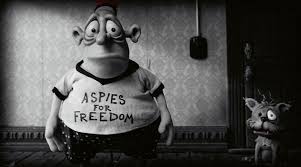
Mary and Max

In recent years there has been a rapid decline in the output of clay animation films. This would appear to be due to the huge increase in CGI animation films from Hollywood, such as 'Wall E' (Andrew Stanton,2008), 'Up' (Pete Docter and Bob Peterson, 2009) and 'Toy Story 3' (Lee Unkrich, 2010) to name but a few. The highly polished, glossy sheen of these films seems to have made the homemade, hand-crafted aesthetic of clay animation a thing of the past. Not, that I am criticising the above mentioned films, on the contrary, I am a huge fan of each, all three being shining examples of just how charming and moving, huge budget Hollywood CGI movies can be when placed in the right hands. However, it is still saddening to see such an imbalance of animation styles on our screens these days.

Thankfully, Adam Elliot’s latest clay animation or ‘clayography’ 'Mary and Max' goes someway to redress this balance. A film of astonishing beauty, 'Mary and Max' is undoubtedly one of THE films of the year. Taking place over the course of twenty years and spanning two continents, the film follows the relationship of pen pals Mary, an eight year old child from Australia, and Max, a forty four year old Jewish man living in New York, suffering from Aspergers syndrome. Through this relationship, Elliot explores the film’s central themes of loneliness, mental illness, love and friendship, all with a deft balance of humour, sadness and subtlety.

Firstly, the clay animation is absolutely impeccable. With an aesthetic that is deceptively child-like, one could easily overlook just how painstaking a process the animation in 'Mary and Max' must have been. This is certainly to the animators and director’s credit, as the style is never too showy or distracting from the unfolding story. Instead, it draws its audience in delicately, allowing its tones and shades to assist in setting the mood.

The balance between the child-like tone and the film’s adult central themes is superbly offset by the narration provided by Barry Humphries, lending itself perfectly to the style of the animation, and allowing the story to be told in way that would be equally fitting to a child’s fairy tale. This is also true of the vocal talent provided by Toni Collette and Philip Seymour Hoffman as 'Mary and Max' respectively, with each adding an extra layer of depth to their characterisation.
The combination of each of these elements makes for a truly exceptional piece of work. Although there are moments of heart-wrenching sadness and a lingering sense of melancholic loneliness throughout, there are also enough moments of quirky humour and touching tenderness to render 'Mary and Max', at times both uplifting and heart-warming. The depth and development of each and every character engages with the viewer in a manner, which would usually seem impossible through animation, such is the strength of Elliot’s script.

For me, 'Mary and Max' should be held in the same regard as Tim Burton’s 'The Nightmare Before Christmas' (1993) as a genuine classic of the clay animation genre. As a genre which is growing ever more redundant at the hand of Hollywood studios’ penchant for big budget 3D and CGI animations, gems such as Mary and Max will inevitably become an even rarer commodity in contemporary cinema, which is why EVERYONE should go see this film at least twice! It really is that good.

Monday, 18 October 2010

The American

As an artist known primarily for his work as a music video director and band photographer, Anton Corbijn’s latest project 'The American', starring George Clooney, could well be seen as a drastic departure from his well established roots. His debut feature 'Control' (2007) yielded great critical acclaim, although some may have noted that being a biopic of the late Ian Curtis, this didn’t really show a significant leap from his usual territory. This time out, however, Corbijn certainly appears to have branched out from those familiar surroundings taking on the spy-thriller genre.

'The American' follows the story of Jack/Edward (Clooney), an assassin and expert weapons builder as he embarks on a task to provide a fellow spy, Mathilde, with a weapon for her next kill. Whilst, on duty he befriends Father Benedetto, a local priest played Paolo Bonacelli, and finds himself romantically drawn to a local prostitute called Clara (Violante Placido). These relationships cause Jack/Edward to reconsider his lifestyle as a hired killer and he decides to make this his final job. Somewhat predictably, things don’t quite pan out so easily.

For various reasons, I found 'The American' crushingly disappointing. Being a huge fan of Corbijn’s work I had possibly set my expectations of the film a little high, yet I still believe 'The American' to be one of the most criminally missed opportunities of the year. It is not Corbijn’s visual skills and sensibilities that are at fault here. The film is replete with stunning shots of spectacular landscapes and beautiful expanses of scenery, which both perfectly emphasise the loneliness of the protagonist and the ability of the artist behind the camera. What IS at fault here is the sense of impending and crushing boredom that sets in around 20 minutes into the piece. Quite simply, 'The American' is a film in which nothing happens for approximately 110 minutes. For long periods, you could be forgiven for thinking that you had walked into an extended perfume or clothes commercial, with many a sequence of Clooney, seemingly performing on autopilot, driving and wandering around alone, looking effortlessly cool, but not doing anything! The only thing he really seems to do is have sex with local prostitute Clara, and with her share a small amount of clunky, unconvincing dialogue.

With regards to Corbijn’s directorial style, as mentioned above, he certainly knows how to compose superb shots and utilise his idyllic surroundings to the highest level. What must be questioned though is his lack of discipline or ability to find an even balance between style and narrative exposition. With such exquisite locations in Italy and Sweden at the heart of the film, Corbijn’s instincts as a photographer take over, resulting in far too many lingering shots that would look great in a holiday brochure, but ultimately hinder and slow the pace of the film.

The performances on display are all perfectly adequate, with the cast making the most of the lacklustre screenplay they have to work with. George Clooney does his usual George Clooney thing as well as ever, providing just the right amount of suave sophistication to the role. Most notably, however, is the performance of Paolo Bonacelli as Father Benedetto. Despite his role being relatively minimal, his presence immediately lights up the screen, conveying a much needed sense of charm and humour to the film.

Somewhere in the midst of this enormous catalogue of, admittedly, wonderful images, was the potential for a fantastically stylish spy movie. With a director of undoubted ability at the helm and a protagonist that appears to be custom built for George Clooney, 'The American' could genuinely have been something special. Sadly, in spite of the cast’s attempts there is nowhere near the required amount of characterisation or plot development. This major flaw makes it almost impossible to invest anything in the protagonist or any of the other key characters. Although commendable for his decision to remove himself from his comfort zone, I for one feel that Corbijn’s vast experience and finely honed abilities at shooting in the world of music and performers is where he clearly excels. Whatever he does choose to work on next, let’s just hope its results are closer to that of the majestic 'Control' and not this forgettable flop.

Friday, 15 October 2010

Leap Year (Ano Bisiesto)

If there is to be a more disturbing or divisive film released this year, it will certainly have to go some distance to top Michael Rowe’s minimalist debut feature Leap Year (Año bisiesto). A depiction of intense loneliness and psycho-sexual torture, or experimentation, depending on which side of the fence you lay, Leap Year raises many a difficult question, with regards to its seemingly complex gender politics.

It follows the life of Laura, played with vulnerable perfection by Monica Del Carmen, a lonely freelance journalist who lives alone in a small Mexican apartment. After a series of one night stands she meets and sleeps with Artur, played by Gustavo Sanchez Parra. Their subsequent relationship grows increasingly violent, with Artur apparently forcing Laura into a chain of appalling, aggressive and demeaning sexual acts. Gradually, however, what initially appears to be a case of intense male dominance, it is Laura who then sets about forcing him into acting out even further acts of sexual violence, reaching a finale that I will not reveal for you here.

Initially, Leap Year left me torn as to whether it is a stark, brutal, and unrelenting portrayal of a woman’s lonely existence, played out with superb complexity, or merely an exercise in repugnant, vulgar and gross misogyny. The first half of the film is pitch perfect. Rowe emphasises Laura’s loneliness beautifully, utilising the tiny confines of her apartment to provide an intimate insight into her sadness. He then goes on to further illustrate the intense nature of her desire for a partner, when we see her staring out of her window whilst masturbating, only to reveal that she is looking at couple just sitting together watching TV. Through a number of one night stands, Laura’s spiralling desperation is made all the more evident, as she is constantly rejected as soon as she tries to establish a connection after they have had sex. To this point in the film, Rowe exerts the correct amount of realism and intensity, drawing us with ease into the world of the protagonist.

However, it is upon the arrival of Artur that things begin to unravel. At first, he appears to be just another one night stand, yet he stays with Laura afterwards, showing her the attention she has so constantly craved from each of her previous encounters. He then returns for a second night, in which we see the first indications as to his violent tendencies. With each passing night that they have sex, his brutality becomes, at times, almost impossible to bear. We see scenes of rape, beating and revolting humiliation, in which Artur forces her to masturbate as he urinates on her.

It is sequences such as those mentioned above that initially left me torn as to Rowe’s intentions with Leap Year. Although the acts are irrefutably degrading, it seems that Laura is the one to really be taking pleasure from them, eventually placing her in a position of power, with her making demands of Artur. However, in spite of this, I, on reflection, believe the second half of Leap Year to be a piece of vile misogynist trash. No matter what Laura’s intentions may or may not be, I can find no justification for creating a ridiculously protracted scene of a woman taking pleasure from a man pissing on her. Or, for that matter, having cigarettes put out on her breasts, or being beaten with a belt.

While some may argue that it is the unflinching, torturous moments which are actually at the heart of the film’s deconstruction of Artur’s character, I could find no argument to stand up against the fact that Leap Year serves only as faux intellectual torture porn.

Friday, 24 September 2010

Rebels Without a Clue

With debut feature Rebels Without a Clue, director and writer Ian Vernon attempts to blend elements of so-called gritty social-realism with black humour, in a film that is about as misguided as it’s unfortunate title suggests. The tagline, ‘Teenagers with guns, drugs and a cool car. All they need to do is lose their virginity’, doesn’t exactly fill one with hope. Its tone being one of slight desperation to attract the teenage, Skins generation via a, shall we say, lack of subtlety and an abundance of brash clichés. It tells the story of four teenagers, who inadvertently interrupt a drug deal and find themselves in possession of drugs, money and a Cadillac. Whilst being tracked by an unnamed thug, they decide to head for Spain in an attempt to escape their current, mundane lives in Manchester.

The key problem with Rebels Without a Clue is the unconvincing and occasionally awkward script. In a film that is primarily centred on an ensemble cast of four, the relationships and the dialogue need to be sharp and engaging if they are to draw one in, yet here, often feels forced and heavy-handed. This is most likely due to the in-authenticity of the interaction between the teens. What should be an entertaining insight into the lives and minds of a group of teens, ends up sounding like an ill-advised guess as to how this generation communicate. This is no more evident than in the all too frequent moments in which, without exaggeration, almost every character to appear on screen refers to Mark (Rik Barnett) as “wanker”. If this is an attempt at humour it comes across as, at best, lazy, and at worst, embarrassing, as though throwing in this word every other minute is somehow going to make teenagers laugh. If not, then it may be that Vernon feels that the constant use of swearing adds to the grittiness or the realism. It doesn’t.

Similarly, the cast on offer fails to capture any sense of realism or comedy. With the exception of Lucy Brennan, who plays Kylie, the performances are wooden and uneven to say the least, although, admittedly, they probably weren’t helped by the equally flawed screenplay. The worst offender though, has to be that of Hylton Collins, whose portrayal of the nameless thug chasing the gang really has to be seen to be believed. In a performance that is so cringe-inducingly bad, I am left unsure as to whether it is deliberately intended as part of the humour. Sadly, I don’t think it is. Dressed all in black, with the words ‘love’ and ‘hate’ tattooed across his knuckles, the thug should have at least seemed intimidating if only in a comic book sense. Unfortunately, the performance holds more in common with Keith from TV show The Office than a scary gangster type. You can almost feel the energy being sapped from the screen whenever he appears, which is a fundamental flaw, considering that this is the character who really needs to be setting the pace in his pursuit of the gang.

Rebels Without a Clue suffers mostly by failing to create an identity for itself. Described as a black comedy, it barely raises enough laughs to call itself a comedy, whilst also lacking anything one might even remotely consider to be gritty or realistic. Additionally, the lack of any consistent or cohesive characterisation further adds to the overall imbalanced tone of the film. All too often, one feels as though Vernon assumes that by simply combining swearing teenagers with dangerous elements such as drugs or guns is an immediate recipe for success, while the reality is that merely putting these components together without a genuine purpose is destined to disappoint.